South Korea retail industry struggles to recover from MERS outbreak
South Korea’s retail sector is enduring one of its most difficult periods as the MERS (Middle East Respiratory Syndrome) outbreak continues to dampen consumer sentiment. More than a month has passed since the first confirmed case, and there are few signs of a swift recovery.
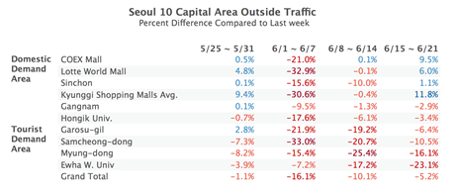
On June 23, ZOYI Corporation, a customer analytics firm, published a foot traffic analysis of major commercial districts across the Seoul metropolitan area. The analysis covered the four-week period from May 25 — when the first MERS patient was confirmed — through June 21. In the first week of June, when the first MERS-related death was reported and Seoul Mayor Park Won-soon held an emergency briefing, foot traffic across all surveyed districts fell by an average of 16.1% compared to the previous week.
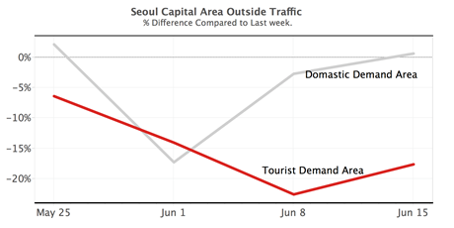
The steepest declines were recorded in districts popular with Youker (Chinese tourist) visitors, including Myeong-dong, Samcheong-dong, Garosu-gil, and the Ewha University area. Samcheong-dong saw the sharpest drop at 33%, followed by Garosu-gil at 21.9% and Myeong-dong at 15.4%. After the government released its list of designated MERS hospitals on June 7, a modest recovery appeared to be underway across most of the city — yet Myeong-dong, Samcheong-dong, Garosu-gil, and the Ewha University district continued to decline, posting drops of 25.4%, 20.7%, 19.2%, and 17.2%, respectively. By the fourth week, double-digit declines persisted in all but Garosu-gil, raising concerns about a prolonged slump in tourist-dependent commercial areas.
Domestically-oriented districts, however, showed relative resilience over the same period. The Gangnam area — near Samsung Seoul Hospital, then considered the epicenter of the outbreak — was widely expected to suffer a severe blow. Gangnam Station’s decline, however, remained in single digits, faring considerably better than other districts. By the fourth week, major shopping destinations such as COEX Mall, Lotte World Mall, and the Sinchon area posted week-on-week gains. This recovery appeared to be driven primarily by couples in their 20s and 30s who felt relatively less at risk from MERS.
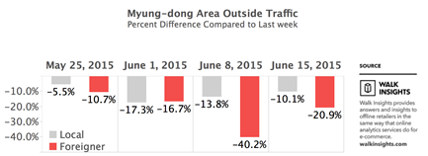
In Myeong-dong, the most tourist-heavy of the affected districts, foot traffic trends diverged between domestic and foreign visitors. Among locals, the rate of decline eased progressively — from 17.3% in week two, to 13.8% in week three, and 10.1% in week four. Among foreign visitors, however, the picture was far grimmer: declines of 16.7%, 38.8%, and 20.9% in weeks two, three, and four, respectively, pointing to a sustained slump with no sign of recovery.
“I had been planning to visit Seoul this vacation, but so many of my colleagues here keep asking whether it’s really safe to go,” said Shin Ji-sun, 33, who works in Beijing. “China went through SARS, so I think people here have a much deeper fear of this kind of outbreak.”
“In the second week of June, foot traffic was down 10.1%, and the third week saw a further decline of 5.2% — roughly half the rate of the prior week,” said Elly Han, Insights Director at ZOYI Corporation. “The number of recovered and discharged MERS patients is rising, and more people are being released from quarantine. I think that’s helping to ease public anxiety and restore a degree of confidence. If this trend holds, most commercial districts should expect to recover their energy by late June to early July. That said, areas dependent on foreign visitors are likely to feel the effects for considerably longer — and targeted government intervention will be critical.”